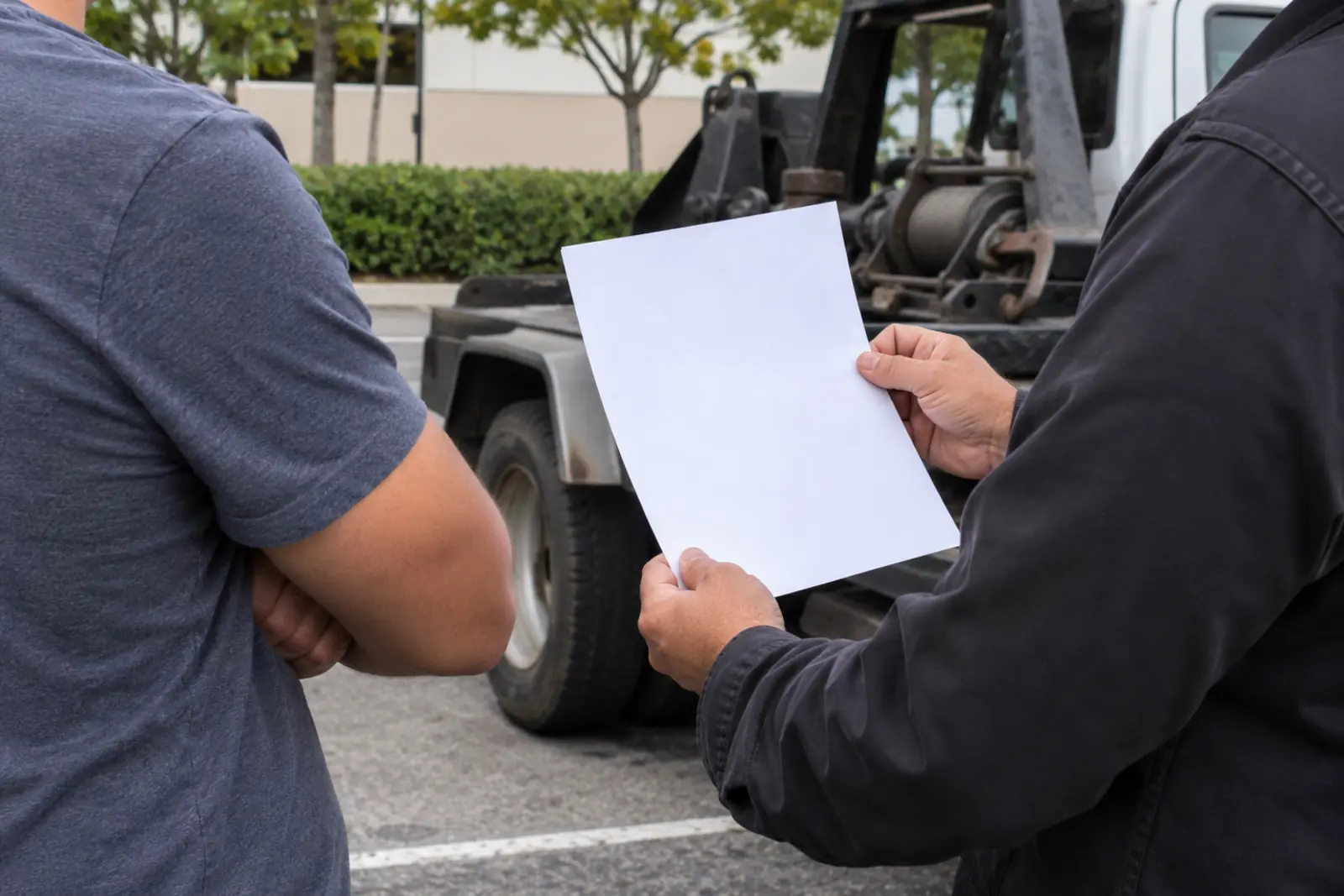
To choose a tow company, decide before the truck arrives: ask for the total price, the truck type and the destination, get an itemized written estimate before the hookup, and decline any truck you did not call. California law backs you up: a tow operator generally cannot stop at a crash scene or beside a disabled car to solicit work, and must give an itemized written estimate before hooking up when the owner or driver is present. Most predatory towing depends on the customer being rushed and not knowing those rules.
Plenty of tow operators run straightforward businesses and work miserable hours doing it. The trouble, when it comes, tends to follow recognizable patterns.
Before you need one
Choosing a company during an emergency is the weakest position to negotiate from. A few minutes of preparation changes that:
- Check what your auto insurance and any roadside membership already cover. Many send their own contractor, which saves you from choosing at all. The plan comparison explains what to look for.
- Pick one local company you have checked, and save its number in your phone along with your insurer's claims line.
- Know your vehicle's drivetrain and whether it needs a flatbed. The flatbed and wheel-lift guide shows how to tell.
Questions to ask on the phone
- What is the total price for the whole job, including mileage, equipment, after-hours charges and any fuel or administrative fees?
- What type of truck are you sending, and will it be able to carry my vehicle?
- Where will you take the car, and what are the yard's hours?
- How soon can the truck get here, and will you call if that changes?
- Do you take credit cards?
- Will I get an itemized written estimate before you attach the car?
A reputable company answers these without irritation. If a dispatcher refuses to give any price, or says that it will be "whatever the driver decides," move on if you have the choice. Write down the company name, the quoted total and the dispatcher's answer, so you can point to it if the price changes at the roadside. For a sense of what a fair quote looks like, see typical towing costs in Fresno.
What California requires of tow operators
| Rule | What it means for you |
|---|---|
| No soliciting at crash scenes or beside disabled vehicles (Vehicle Code 22513) | A truck that appears uninvited should not be there unless law enforcement or a public agency asked for it, or you or the driver summoned or flagged it |
| Itemized written estimate before hookup (22513) | If you or the driver are present, the operator must provide one that lists the company's name and address, motor carrier permit number, the truck's plate, the driver's name, each service and its cost, and storage as a 24-hour rate |
| No charge above the estimate without consent (22513) | If the final bill is higher, you can decline the difference unless you approved it |
| Fee limits on police-directed tows (22513) | The cap is the greater of the rate in the company's agreement with the agency or the rate approved by the CHP for that operator |
| Records kept three years (22513) | Operators must keep records of who summoned them, plus estimates and invoices, and produce them for law enforcement on request |
| Private-property tow rules (22658) | Signs, written authorization, police notification, card payment and release rules; see the private property guide |
The estimate rule has exceptions: motor club tows and tows performed under contract at the direction of a law enforcement or public agency are exempt from the pre-hookup estimate requirement, and an officer-directed estimate can be completed after the car is moved to the nearest safe place. The statute is at the California Legislative Information site.
Tow truck scam red flags and signs of predatory towing in California
Predatory towing is not one trick but a handful of repeating ones: a truck that shows up uninvited, a price that grows, a yard that is hard to reach, and a demand for cash. Watch for these:
- The truck arrived before you called anyone, especially at a collision.
- No price, or a price that changes between the phone call and the roadside.
- Pressure to sign immediately, or a form with blank spaces.
- A destination you did not choose, particularly a yard that is far away, hard to reach or closed on weekends.
- Cash only. Yards holding cars removed by police under Vehicle Code section 22651 must accept cash or a valid bank credit card in your name (store cards excluded) under section 22651.1. Tow operators in the CHP's rotation program must accept a valid bank card, and yards that hold private-property tows must too.
- A company name that does not match the truck, the paperwork and the phone greeting.
- Refusing to let you retrieve personal belongings. For CHP tows, personal property must be handed back without charge during business hours; see the accident towing guide.
- Vague or missing permit information. The written estimate is supposed to show a motor carrier permit number.
According to the CHP's rotation tow consumer information, a tow operator may not place a lien on personal property inside a vehicle, and that property must be released to the owner or an agent on demand, without charge, during normal business hours.
Rotation tow or your own choice?
| Rotation tow (called by police) | Company you choose | |
|---|---|---|
| Speed | Quick at a freeway or blocking scene | Depends on the company |
| Price control | Rates set under the agency's agreement | You negotiate and get it in writing |
| Destination | Usually the company's yard | Often your shop or home |
| Oversight | The agency that runs the rotation list | Your own paper trail is your protection |
The CHP Rotation Tow Program page explains how the rotation works. If something goes wrong with a CHP rotation tow, start with the CHP Area office that handled the call.
On a freeway, the choice may not be yours at all. The CHP says the Freeway Service Patrol provides service to motorists at no cost, so on a covered freeway it is worth asking dispatch whether a patrol truck is available before accepting a paid tow; the freeway breakdown guide covers the first minutes. If the car has been moved to a yard and you cannot tell where, the guide to finding a towed car walks through it.
Protecting yourself on the day
- Photograph the car, the truck, its plate and the driver's name or badge if shown.
- Get the written estimate before the hookup and read the total.
- Take valuables and documents out of the car.
- Pay by card and ask for an itemized invoice that matches the estimate.
- If you are given a form to sign, make sure it is completed, and keep a copy.
If the bill does not match the estimate, say so politely, ask for the itemization, and pay only what you agreed to if you can. Disputes after accident tows are explained in the accident towing guide, and for a sense of what a fair bill looks like, see typical towing costs.
How to file a tow company complaint in California
Where a complaint goes depends on who ordered the tow. Keep the estimate, invoice, photos and card receipt, and note the date, time and the truck's plate.
- CHP-ordered tow: contact the CHP Area office that handled the call. The CHP rotation tow page says the parent Area investigates a tow complaint from an incident outside that Area, and links to a commend or complain page.
- City police tow: contact the police department that ordered it.
- Private-property tow: start with the local traffic enforcement agency; the rules are in the private property guide.
- Money you believe was overcharged: small claims court is available, and a card payment lets you also ask your card issuer to dispute the charge.
Frequently Asked Questions
Is it legal for a tow truck to show up at an accident without being called?
Generally not. California Vehicle Code section 22513 prohibits stopping to solicit towing at an accident scene or beside a disabled vehicle, except when summoned by law enforcement or a public agency, or when the vehicle's owner or driver called or flagged the truck.
Do tow companies have to give me a written estimate?
If the owner or driver is present, the operator must give an itemized written estimate before attaching the vehicle, with some exceptions such as motor club tows and agency-directed tows. The estimate must include the company's motor carrier permit number.
Can a tow company charge more than the estimate?
Not without the owner's prior consent under section 22513. If the final bill is higher than the estimate and you did not agree to the increase, ask for an itemized explanation.
Where do I complain about a tow?
For a tow arranged by the CHP, start with the CHP Area office that handled the call; for a city police tow, the police department. For private-property tows, start with the local traffic enforcement agency. Small claims court is available for money disputes.
Should I pay a tow company in cash?
Avoid cash-only demands. A card lets you dispute a charge, and rotation-program operators must accept a valid bank card. Always get an itemized receipt.
Can a tow company keep my personal belongings?
On a CHP tow, no. The CHP says operators may not place a lien on personal property in the vehicle, and it must be released on demand without charge during normal business hours.
Is there a free option instead of a paid tow on the freeway?
Sometimes. The CHP states that the Freeway Service Patrol provides service to motorists at no cost, so ask the dispatcher whether a patrol truck covers your location.